
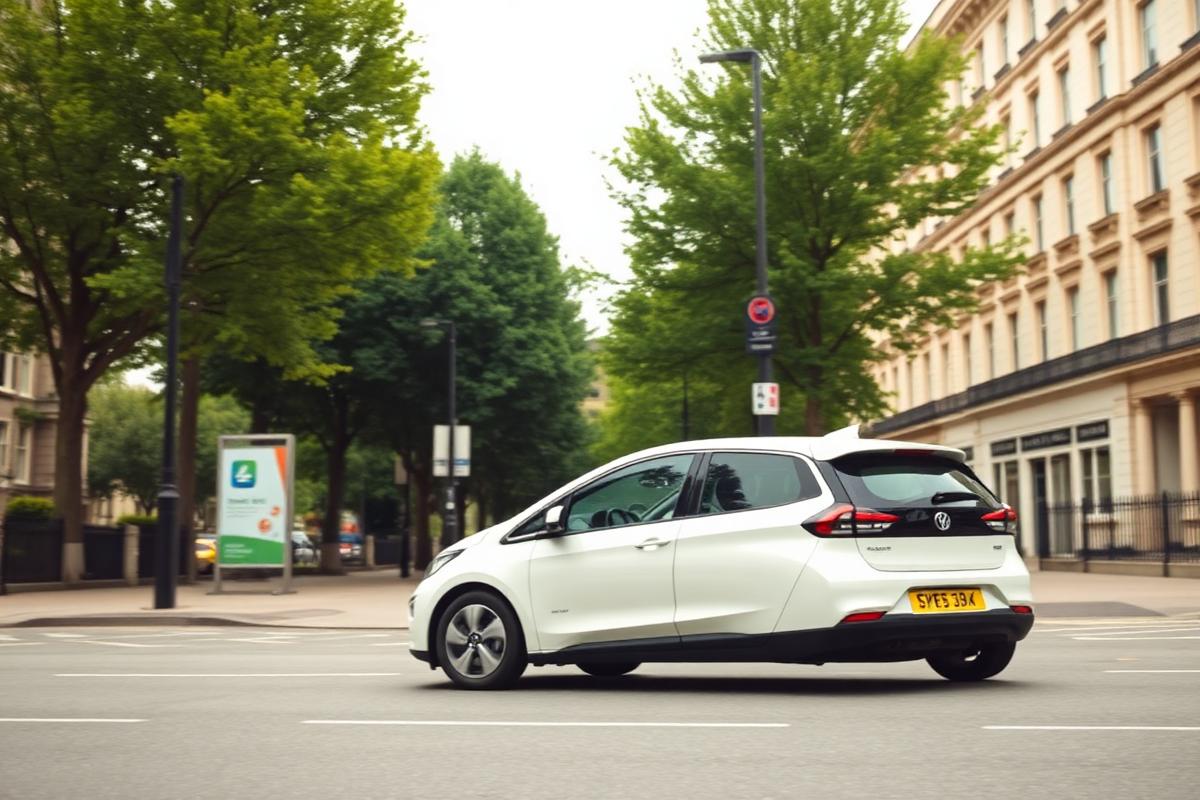
ULEZ and CAZ compliant cars on finance — what to buy without stranding yourself
- FCA regulated
- No obligation
- Free to check
- ULEZ minimumEuro 6 diesel / Euro 4 petrol
- Charge (London)£12.50 per day
- CAZ citiesBirmingham, Bristol, Sheffield, others
- Residual riskNon-compliant cars fall faster

A car finance agreement is a long-term commitment. Clean-air zone rules move faster than a 4-year term. A car that is compliant today can be non-compliant in the middle of the agreement if the emissions standard tightens — and a non-compliant car being driven daily in Central London or a UK Clean Air Zone racks up daily charges that eclipse any monthly finance saving. This guide sets out which vehicles stay compliant through the length of a normal finance term, why the residual value risk is different for a taxi or PHV driver than for a private buyer, and how (A car finance product where you pay a fixed monthly amount and own the car outright at the end of the term.) compares to (A car finance product with lower monthly payments and a large optional final payment (the balloon) if you want to keep the car.) for full-time commercial mileage.
The compliance standards you need to know
London's Ultra Low Emission Zone (ULEZ) requires diesel vehicles to meet Euro 6 emissions and petrol vehicles to meet Euro 4. Non-compliant vehicles pay £12.50 per day. Clean Air Zones (CAZ) in Birmingham, Bristol, Sheffield, Bradford, Portsmouth, Newcastle and Tyneside apply broadly the same standards for cars and taxis, with variations in daily charge and vehicle categories covered. Manchester's zone has been paused; Glasgow operates a Low Emission Zone using the same standards. A driver who buys a non-compliant diesel today, thinking 'I only work outside London', is one licensing area change away from a serious problem.
- Definition
- Euro 6The current EU emissions standard for cars and light commercial vehicles.Euro 6 covers cars registered from September 2015 (some earlier for specific models). It sets tight limits on nitrogen oxides (NOx) and particulate matter. Euro 6 diesel vehicles are ULEZ and CAZ compliant; Euro 5 and earlier diesels are not.
Compliance by fuel type
| Fuel | Minimum standard | Typical registration year | Charge if non-compliant |
|---|---|---|---|
| Petrol | Euro 4 | 2005 onwards (most models) | £12.50/day (ULEZ) |
| Diesel | Euro 6 | September 2015 onwards | £12.50/day (ULEZ) |
| Hybrid petrol | Euro 4 petrol standard | Post-2005 typically | Same as petrol |
| Plug-in hybrid | Euro 6 petrol/diesel base | Post-2015 typically | Same as base fuel |
| Fully electric | Zero-emission | Any BEV | Nil — always compliant |
Why residual values matter more for taxi drivers
A private car buyer expects the car to hold most of its value over 3 years. A taxi driver's car does 4 to 6 times the private mileage, so wear-and-tear residual value drops faster to start with. Add compliance risk — a further tightening of the ULEZ standard, or expansion of a CAZ into new cities — and a non-compliant taxi at the end of a 4-year term is worth materially less than a compliant one. Lenders know this: it is one reason taxi HP typically carries a higher deposit than personal HP, and one reason PCP is rare for full-time drivers.
The saddest cases are drivers stuck in year three of an HP on a 2013 diesel they bought before ULEZ went national. They cannot economically drive it, cannot sell it for anything close to the outstanding balance, and cannot afford to swap out. A compliant car at the start would have avoided all of it.
HP vs PCP for full-time commercial mileage
PCP is built around a (The minimum value the lender guarantees your car will be worth at the end of a PCP agreement, based on agreed mileage and condition.) (GFV) at the end of the term. That value has to be sensible for the finance company or the maths does not work. On a full-time taxi car projected to do 60,000 miles a year, the GFV three or four years out is very low — either the finance company refuses to write PCP, or the monthly payment barely differs from HP because the GFV is nearly zero. The vast majority of taxi and PHV finance is therefore HP over 36 to 48 months, with a fair deposit of 10–20% depending on the vehicle.
HP is also the cleaner product for high-mileage drivers. Excess-mileage charges on PCP scale quickly at 6–10p per mile over the contracted limit; a taxi driver on a personal PCP would run up thousands in excess-mileage charges. HP has no mileage clause. You drive as much as you want; the residual value is your problem to solve when you come to sell.
The clean-air compliance checklist before signing
- Check the exact registration date and Euro standard for the vehicle — not just the model year — via the DVLA vehicle check.
- Confirm the vehicle is currently compliant in every zone you drive in — TfL's compliance checker is the definitive source for London.
- Check the vehicle is still on your licensing authority's approved list — TfL and most councils publish age and fuel-type restrictions.
- Consider whether emissions rules may tighten during the term of the agreement — read consultation notes from London Assembly and DfT.
- For diesel — prefer post-2018 models where possible, so you have headroom against a possible tightening to Euro 6d.
- For petrol hybrid — verify the base petrol engine is Euro 6, not just Euro 4.
Illustrative — total 4-year cost, compliant vs non-compliant
Numbers are illustrative. Actual outcomes depend on how many days a year you drive in the zone, the specific vehicle, and any future changes to daily charges. The chart's job is to show that a compliant vehicle bought right at the start is materially cheaper over the term than an initially cheaper non-compliant one, once the daily charges are counted in.
The scrappage and grant landscape
TfL has run scrappage schemes for London taxi and PHV drivers moving from non-compliant to compliant vehicles; other CAZ cities have run local equivalents. These come and go — check the current scheme before assuming one is available. Where a scheme is live, it can materially change the maths of upgrading part-way through a finance term: some drivers can settle the outstanding HP on a non-compliant vehicle and roll into a compliant one at a lower total cost than continuing.
What about electric?
A full battery-electric taxi is always compliant, has near-zero running fuel cost, and qualifies for most licensing authorities' newest-vehicle categories. The trade-offs are higher purchase price, dependence on charging infrastructure for high-mileage use, and battery degradation over 4-year commercial mileage. For urban PHV drivers with home or depot charging, BEV finance can be cheaper over the term than a hybrid HP once fuel is counted in. For rural drivers or long-haul PHV, the fit is worse. Ask a broker who specifically models the total-cost-of-ownership rather than the sticker price.
Where to go from here
If you have not yet arranged the finance itself, our taxi-specific finance guide explains why a personal HP will not cover plated use. If affordability documentation is the immediate blocker, our self-employed income guide covers what lenders actually accept. The Taxi and PHV hub links to a named adviser on our panel who can run through vehicle shortlists against your licensing authority.
Sources
- Transport for London · ULEZ — Ultra Low Emission Zone · 1 November 2024
- GOV.UK · Clean Air Zones — check a vehicle · 1 October 2024
- DVSA · Vehicle emissions and Euro standards · 1 June 2024
- SMMT · UK new car market and emissions · 1 September 2024
- DfT · Zero-emission road transport strategy · 1 May 2024
- Transport for London · Taxi and PHV vehicle age and emissions rules · 1 August 2024
Common questions
Will ULEZ get stricter during the term of my finance?
The current standard has held for several years, but a tightening to a Euro 6d-only standard has been discussed. Buying newer than the current minimum is the cheapest insurance against a future tightening.Are hybrid cars automatically ULEZ compliant?
No — a hybrid is treated by its base fuel type. A Euro 4 petrol hybrid is compliant; a pre-2015 diesel hybrid is not. Check the specific vehicle, not the badge.Can I refinance if the rules change mid-agreement?
Refinancing an HP mid-term is possible but usually expensive unless there is equity in the vehicle. The cheaper protection is buying compliant at the start.Does the daily ULEZ charge apply if I only pass through the zone briefly?
Yes — any journey inside the zone in a non-compliant vehicle on a chargeable day costs the full daily charge, regardless of how far you drive.Is a fully electric taxi a good bet for finance?
For high-mileage urban drivers with reliable charging, usually yes. For rural or long-haul PHV drivers, run the total-cost-of-ownership numbers carefully before signing.
Check what you'd be offered — no impact on your credit score.
Real people, straight answers. Talk to us before you apply if you want to.
People also ask
Can I finance any car for taxi or private hire work?
No. Every licensing authority publishes an eligible-vehicle list — age caps, emissions standards, sometimes wheelchair-accessibility or colour rules — and only cars that meet those rules can be plated. Separately, some regulated finance lenders exclude hire-and-reward use in their acceptance criteria. Check both the council list and the lender's policy before you commit to a specific vehicle.
How do I prove my income if I drive across multiple apps?
Most taxi-friendly lenders accept three months of personal or business bank statements alongside your most recent SA302 or accountant's letter. Platform earning summaries from Uber, Bolt or Free Now help as corroborating evidence but rarely stand alone. A driver in their first trading year should speak to an adviser about bridging with an accountant's letter before applying.
Can I quietly use a personal HP for taxi work?
No. The clause is standard and enforceable. Insurers, licensing authorities and even DVLA plate records make it visible. The finance company can call the agreement in default and the insurer will void cover.
From Taxi car finance explained — why a personal HP will not cover plated use
Do all lenders offer taxi finance?
No. It is a specialist product on a narrower panel. Most mainstream personal finance lenders do not offer it; a broker with a taxi desk arranges via a hire-and-reward-approved panel.
From Taxi car finance explained — why a personal HP will not cover plated use
Related reading

Car finance for taxi and private hire drivers
Finance for private hire and hackney drivers: council PHV eligibility, self-employed income proof, ULEZ and clean-air-zone compliant vehicles, and how

Taxi car finance explained — why a personal HP will not cover plated use
Personal car finance does not cover taxi or PHV use. The three vetoes — licensing, lender, insurer — and how taxi-specific HP works in practice, without

Proving income as a self-employed driver — the documents lenders actually accept
Bank statements, SA302s and platform summaries — what lenders actually accept as proof of self-employed driver income, and how to package a tidy