
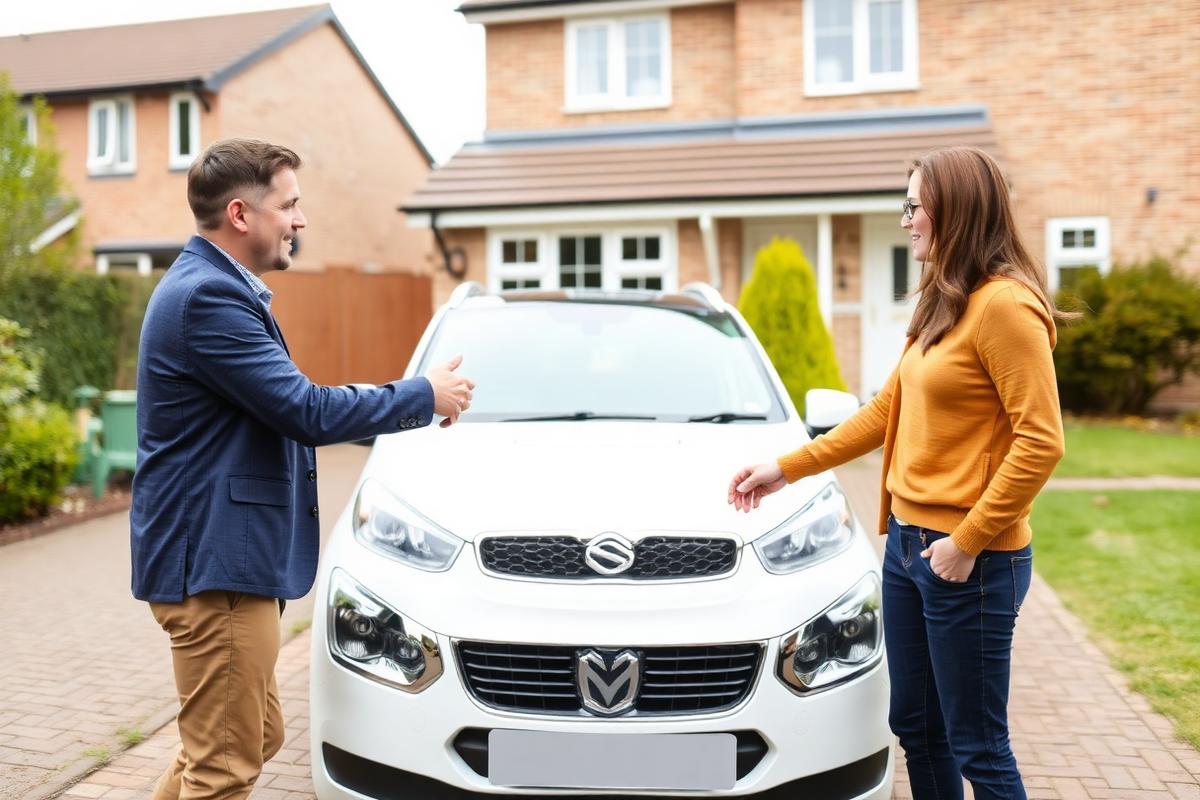
Buying privately — the cheapest and riskiest channel
- FCA regulated
- No obligation
- Free to check
- Price vs trader8–15% cheaper
- Consumer Rights ActDoes not apply
- Finance accessVery limited
- Legal basis'Sold as seen' + Sale of Goods
- Recommended forCash buyers, experienced

A private sale is a car sold between two individuals, neither acting in the course of a business. It is the cheapest way to buy a used car in the UK — for a reason. The Consumer Rights Act 2015 does not apply. The Motor Ombudsman scheme does not apply. Almost no UK motor finance lender will fund the purchase. Section 75 of the Consumer Credit Act does not attach. What you have instead is Sale of Goods Act residue, the common-law rule against misrepresentation, and a small-claims track that costs more in time and stress than it recovers on all but the largest disputes.
That doesn't make private sales a bad idea. Every year hundreds of thousands of UK private-sale transactions complete without incident and save the buyer meaningful money against the equivalent trader price. But the buyer is doing work the dealer would otherwise have done — running the checks, verifying title, testing the car, absorbing the risk of anything that goes wrong after the money changes hands. Understanding exactly what work is transferring is what separates a successful private sale from an expensive one.
The one thing the buyer must accept
Every recommendation below assumes you understand and accept the core position: a private car sale in the UK is 'sold as seen'. The seller is only required to describe the car honestly and pass legal title. They are not required to guarantee condition, fitness for purpose, satisfactory quality or any future performance. If the gearbox fails a week after purchase, your only route to redress is to prove the seller knew and misrepresented — a much higher standard than the Consumer Rights Act's 'satisfactory quality' test, and one most small-claims tribunals will decline to find in the buyer's favour on ordinary mechanical failures.
The five checks that catch almost every private-sale scam
- V5C in the seller's name at the sale address — cross-check on the day of viewing.
- Paid vehicle history check (HPI, AA, RAC or CarVertical) run the day before — outstanding finance, write-off category, mileage discrepancies, stolen markers, VIN and V5 cross-check.
- MOT history on gov.uk/check-mot-history — every advisory and failure since first registration.
- Recall check on gov.uk/check-vehicle-recall — outstanding manufacturer recalls.
- In-person cold-start test at the seller's home address (not a neutral meeting point) — a warm engine or a public meet-up is a warning sign.
Every one of those five checks is cheap. A paid history check costs under £20; the gov.uk checks are free. The address confirmation on the V5C is worth more than it sounds — the overwhelming majority of private-sale fraud in the UK involves either a seller who does not legally own the car, or a car that has outstanding finance against a previous owner. The V5C address check plus the paid history check catch both patterns almost every time.
Where the money actually gets lost
The two lines that matter most on that chart are outstanding finance repossession and cloned vehicles. Both are near-total losses — in a cloning case the car is legally the police's to reclaim once identified, in a finance repossession case the lender's title trumps the buyer's — and both are almost entirely caught by the paid history check plus the V5C address check. Everything else on the chart is smaller-dollar and easier to negotiate around after the fact.
- Definition
- Vehicle cloningThe practice of copying the identity of a legitimate UK-registered car onto a stolen or fraudulent one, using the same registration mark, VIN plate and paperwork.Cloned cars are the most expensive private-sale scam in the UK. Once identified — usually by ANPR mismatch, DVLA record check or subsequent finance-house recovery — the car is legally the police's to reclaim, and the buyer's civil claim against the seller is usually against a person who no longer exists. Paid history checks flag most clones; some slip through. Buy from the seller's home address on the V5C to reduce the risk to near zero.
Finance and private sales
The overwhelming majority of UK motor finance lenders will not fund a private-sale car. This is because the lender wants a clear invoice from a VAT-registered trader for the exact purchase amount, a clear chain of title, and Consumer Rights Act protection to sit alongside their loan. A private sale delivers none of the three. A small number of specialist personal-loan providers will lend an unsecured loan large enough to buy a car privately — but the rate is meaningfully higher than a comparable (A car finance product where you pay a fixed monthly amount and own the car outright at the end of the term.) or (A car finance product with lower monthly payments and a large optional final payment (the balloon) if you want to keep the car.) because the loan is not secured against the vehicle, and if the car turns out to be stolen or finance-encumbered, the borrower still owes the lender the full amount.
I get calls every week from customers who saw a private-sale bargain and want us to finance it. On our panel, the answer is almost always no — and I don't try to soften it. The reason isn't that we don't want their business; it's that we can't secure a loan on a car that might turn out to be someone else's. The customer's own money can go private. Borrowed money can't.
The transaction itself
Assuming you've done every check and decided to proceed, the physical transaction protects itself if you follow four rules. Pay by bank transfer in the seller's presence — never cash, which offers no proof of payment and no reversibility on fraud. Complete the V5C 'new keeper' section together and post the seller's copy on the day, or use the DVLA's online change-of-keeper service. Receive both keys, the service book, all MOT certificates the seller holds, and every fob the car came with originally. And get a simple written invoice — a sheet of paper listing the seller's name, address, the car's VRM, VIN, mileage, sale price and date, signed by both parties. The invoice is what makes any subsequent civil claim actually work.
| Protection | Trader (any) | Private sale |
|---|---|---|
| Consumer Rights Act 2015 | Full | None |
| 30-day right to reject | Yes | No |
| Section 75 (finance) | Yes on credit | Not applicable |
| Motor Ombudsman | Yes if member | No |
| Warranty | 3–24 months typical | None |
| Legal claim if things go wrong | CRA 2015 + finance provider | Small claims + misrepresentation only |
The bottom line
The single most important predictor of a successful private-sale outcome in the UK is the completeness of the pre-purchase check list. Broker case files consistently show that buyers who complete all five recommended checks — V5C at the sale address, paid history check, MOT history, recall check, and a cold-start inspection at the seller’s home — report satisfactory outcomes at rates comparable to trader-channel buyers. Buyers who skip even one of those checks report meaningfully worse outcomes, and the outcomes deteriorate steeply with each additional skipped check.
None of this changes the fundamental point that private sales in the UK are best suited to buyers who can absorb a bad outcome without financial hardship. The savings against trader-channel pricing are genuine but they are a compensation for risk, not a discount. The buyer who can walk away from a lost purchase with no more than an expensive weekend of frustration is the buyer for whom private sale is the right choice. The buyer who cannot absorb the loss should pay the trader premium for the Consumer Rights Act protection that comes with it. Both are legitimate positions; only one of them is right for you on any given purchase.
Beyond the checks themselves, the practical advice from a decade of broker case-review notes on private-sale disputes is simple. Buy from the address on the V5C. Bring a friend. Pay by transfer. Get a written invoice. Photograph everything. Never let a seller pressure you to complete on the day of viewing — legitimate private sellers will wait 24 hours while you sleep on it, and the sellers who will not are the sellers whose cars you should not buy.
Sources
- gov.uk · Buying and selling a vehicle · 1 January 2026
- gov.uk · Check MOT history · 1 January 2026
- gov.uk · Check if a vehicle has been recalled · 1 January 2026
- Legislation.gov.uk · Consumer Rights Act 2015 · 26 March 2015
- Legislation.gov.uk · Misrepresentation Act 1967 · 10 April 1967
- Action Fraud · Vehicle scams reporting · 1 January 2026
Common questions
Is a private sale legally binding?
Yes, from the moment money changes hands and the V5C is signed over. There is no cooling-off period on a private car sale — no equivalent of the Consumer Credit Act's 14-day withdrawal right, because no regulated credit is involved. The transaction is final.What if the car turns out to have outstanding finance?
The finance company retains legal title to the car and can reclaim it, even from a buyer who paid in good faith. Your civil claim is against the seller — usually recoverable only if the seller is traceable and solvent. Always run a paid history check before paying.Can I finance a private-sale car with a personal loan?
Yes, a small number of unsecured personal-loan providers will lend for private car purchases. The rate is meaningfully higher than a comparable HP or PCP because the loan is not secured. Compare total cost carefully against a dealer route.What if the mileage was clocked?
Clocking is a criminal offence under the Fraud Act 2006 and a civil misrepresentation under the Misrepresentation Act 1967. Recovery depends on being able to prove the seller knew — MOT history from gov.uk usually provides the evidence.Should I take the car to a mechanic before paying?
On any private-sale car over £3,000, yes. AA and RAC inspections cost £150–£250 and are worth many times that on the risk they filter out. A seller who refuses to allow an inspection is telling you something worth listening to.Is it safer to buy from someone I know personally?
Not automatically. Personal relationships add social pressure to complete a deal that the checks might not support. Run the paid history check, verify the V5C address, and MOT history on any private sale — including from friends and family — before paying.
Check what you'd be offered — no impact on your credit score.
Real people, straight answers. Talk to us before you apply if you want to.
People also ask
How long does buying a car in the UK actually take?
From opening a shortlist to driving the car home, 2 to 6 weeks is typical. A used-car purchase with an existing soft-search quote can be done in 48 hours; a bespoke new-car order from a factory sometimes takes 3 to 6 months.
Is buying privately worth the saving?
Only if you accept the loss of consumer protection and the near-total loss of finance options. On a mainstream car, the private-sale saving is often absorbed by the higher risk of undisclosed faults and the difficulty of financing the purchase.
Is a franchised dealer always more expensive than an independent?
On a like-for-like car, almost always yes — 5% to 10% higher is typical. The premium buys the approved-used inspection, extended manufacturer warranty and breakdown cover. Whether it's worth paying depends on the age of the car and how much you value the branded support network.
From Buying from a franchised dealer — what you actually get
Does the manufacturer warranty transfer if I sell the car privately later?
Yes. Approved-used warranties are attached to the vehicle, not the buyer, and transfer automatically to any subsequent private owner within the warranty period. This is one of the reasons approved-used cars hold their value slightly better on resale.
From Buying from a franchised dealer — what you actually get
Related reading

Buying a car in the UK — the complete 2026 journey
How to buy a car in the UK end-to-end: budget, product, sourcing, viewing, checks, negotiation, paperwork, delivery and the first 30 days.
Buying from a franchised dealer — what you actually get
Franchised main dealers cost more but deliver approved-used inspections, manufacturer warranty and easier finance. 2026 pros, cons, negotiation.
Buying from an independent dealer — the fair-value channel
Independent dealers price closer to the market and negotiate harder than franchised. Full 2026 guide: what to check, protection, finance and pitfalls.