
The used-car viewing checklist — 40 checks in under 30 minutes
- FCA regulated
- No obligation
- Free to check
- Checks in the sequence40
- Total time20–30 minutes
- Road-test minimum15 minutes
- Most-missed checkCold start
- Second-most-missedV5C address

The viewing is the single most valuable half hour of the entire buying process. Every trader knows what a well-run viewing catches, and — for the traders whose stock will survive it — good ones welcome buyers who know how to look. For the small minority who hope you won't spot what they didn't fix, this checklist is exactly what they don't want you to bring. Print it, take it, tick as you go. It is not rude to be systematic; it is expensive not to be.
The sequence is important. Cold-start diagnostics disappear the moment the engine is warm, so that check has to come first. Panel checks come second because the light in the yard is best for them; move under cover to a workshop and half the paint mismatches disappear. Underbonnet checks require a fully cold engine — never open the radiator cap on a hot car. Cabin and electrics can wait. The road test is last because it exposes anything the earlier checks missed while giving the seller a witness in the seat. Paperwork verification closes the sequence back at the seller's premises.
Cold start — checks 1 to 5
- 1. First-key-turn: no hesitation, no cranking, engine catches within 2–3 revolutions.
- 2. No blue or grey exhaust smoke on first start — a puff for half a second is normal, sustained smoke is not.
- 3. Every dashboard warning light illuminates on ignition, then extinguishes within 5 seconds of the engine catching.
- 4. No hydraulic-lifter tick or ticking noise that fades as oil circulates — noise that stays after 30 seconds is a red flag.
- 5. Idle stabilises within 15 seconds and holds steady between 700 and 900 rpm — swinging idle is an unresolved fault.
| Time spent viewing | Cars viewed | % reporting a fault within 30 days | % reporting a major fault within 90 days |
|---|---|---|---|
| Under 15 minutes | impulse buyers | 41% | 18% |
| 15–30 minutes | typical buyers | 27% | 11% |
| 30–60 minutes | prepared buyers | 14% | 5% |
| Over 60 minutes with checklist | disciplined buyers | 6% | 2% |
Exterior panels and glass — checks 6 to 15
- 6. Panel gaps: bonnet-to-wing, boot-to-quarter, door-to-B-pillar — all even, both sides.
- 7. Paint match: bonnet, doors, wings and roof under the same natural light — any 'shade shift' is respray or replacement.
- 8. Overspray on rubber seals, plastic trims and around badges — a certain sign of respray.
- 9. Paint ripple in low sunlight — hold your head level with the panel and look across it.
- 10. Windscreen chips or cracks — anything larger than 10mm in the driver's swept area is an MOT failure.
- 11. Rear screen for delamination and heater elements working (test in cabin phase).
- 12. All external lights present, undamaged and matching front-to-back.
- 13. Wing mirror housing colour matches body and mechanisms fold in both directions.
- 14. Boot floor and spare-wheel well — lift the mat, look for water staining and rust bubbles.
- 15. Underside of the sills at the jack points — the single most-missed rust check on any UK used car.
Wheels, tyres and brakes — checks 16 to 22
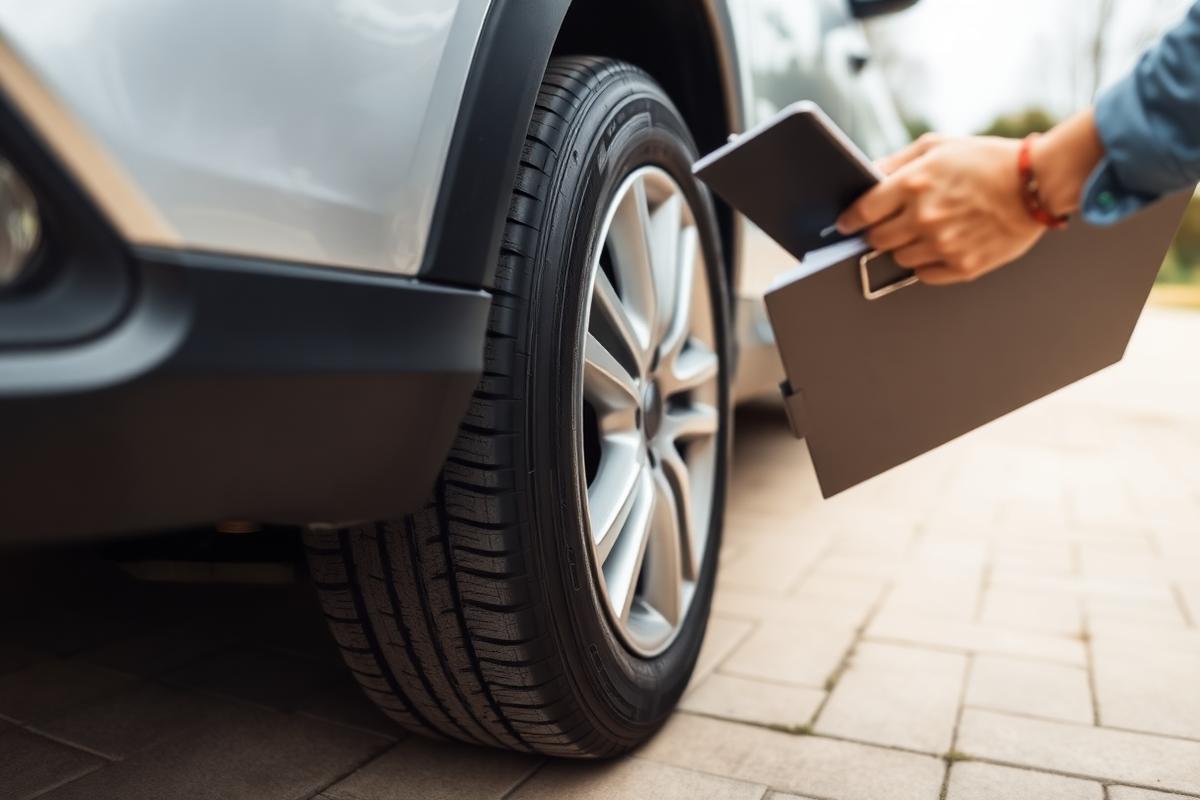
- 16. Tread depth on all four — legal minimum 1.6mm, replacement point 3mm.
- 17. Even wear across the tread — inner or outer edge wear means tracking; centre wear means over-inflation.
- 18. Matching brands front and rear on the same axle — mismatched tyres are legal but suggest a corner-cutting owner.
- 19. Kerbing damage on all four alloys — cosmetic, but a negotiation lever.
- 20. Locking wheel-nut key present in the boot — replacement locks cost £80–£150.
- 21. Brake disc lip: a lip of more than 1–2mm on the outer edge means the discs are approaching replacement.
- 22. Handbrake holds firmly at 3–5 clicks on a slight incline (test on the road test if the yard is flat).
Underbonnet — checks 23 to 28
- 23. Oil level between MIN and MAX on the dipstick; oil colour amber to dark brown, never grey (mayonnaise) or black-and-gritty.
- 24. Coolant level between MIN and MAX; colour red/pink/blue as specified — never brown (rust) or oily.
- 25. No fresh grease or wet weeping on any hose, gasket or fitting.
- 26. Battery terminals clean, no white corrosion, and battery secured by an OEM clamp.
- 27. Air filter housing sits square and clips shut — sagging or missing clips suggest recent cheap work.
- 28. Auxiliary belt visible from above shows no glazing, cracking or missing chunks.
Cabin and electrics — checks 29 to 33
- 29. Every dashboard warning light illuminates on ignition (repeat of check 3) — a bulb removed to hide a fault is fraud.
- 30. Air-con blows genuinely cold within 90 seconds on a warm day. Weak cold air is usually a regas but can be a compressor.
- 31. All four windows and any sunroof operate fully open and fully close, both sides.
- 32. Seatbelts retract fully on all seats — the retractor mechanism is the second-most-failed part after the compressor.
- 33. Head restraints, ISOFIX brackets, boot parcel shelf, load cover and rear seat folding mechanism all present and operating.
Road test — checks 34 to 38
- 34. Cold pull-away in first gear: no clutch judder, no gearbox whine, clean take-up.
- 35. Full-throttle acceleration through the gears: no flat-spot, no drop in power, no smoke visible in the rear-view.
- 36. 60 mph cruise for at least 3 minutes: engine temperature stable, no vibration through the steering wheel, no drift under light-throttle cruise.
- 37. Hard brake on a clear straight from 40 mph: no pulling to either side, no vibration through the pedal, no ABS warning.
- 38. Sharp turns left and right under light load: no clunking from the driveline, no CV-joint knock on tight full-lock.
If a seller refuses a road test, or offers you 'a quick spin around the block' instead of the full 15 minutes, you have your answer. Every fault I've ever helped a customer negotiate off a price came out on a proper road test. The road test is not a formality — it's the whole point of viewing.
Paperwork on the day — checks 39 and 40
- 39. V5C in the seller's name at the address you're viewing from; MOT certificates and service book stamps consistent with the mileage on the odometer.
- 40. Both keys, all fobs, locking wheel-nut key, service book, owner's manual and any manufacturer warranty documentation — physically present and handed to you before payment.
- Definition
- V5CThe DVLA-issued vehicle registration certificate ('logbook') that records the current registered keeper of a UK car. Not proof of ownership, but proof of who is legally responsible for the car.The V5C should show the seller's name at the sale address on the day of viewing. If it doesn't — different name, previous address, brand-new V5C dated within the last month — pause the transaction until the discrepancy is explained. Cloned vehicles and finance-encumbered cars are almost always spotted at this check.
What to do if a check fails
A failed check is not automatically a walk-away — most cars will fail two or three of these forty. What matters is which ones. Cold-start faults, paperwork discrepancies, and safety-critical failures (brakes, seatbelts, structural rust) are walk-away signals. Cosmetic issues (kerbing, small paint mismatch, minor interior wear) are negotiation levers. Wear items approaching replacement (tyres at 3mm, brake discs with a small lip, oil due for a change) are worth £100–£300 off the price. Get any agreed price adjustments in writing on the invoice before you pay, not verbally on the forecourt.
The bottom line
The value of the checklist is not the individual items — it is the discipline of running them in the right order every time. Broker case files consistently show that most avoidable losses cluster around the same handful of missed checks: the cold-start diagnostic, the V5C address, and the road-test findings that never get made because the buyer accepted a shortened viewing. Everything else on the list matters, but those three are where the biggest returns come from.
Adopt the checklist as a habit rather than a one-off exercise and the compounding is meaningful. Every used-car viewing you do more thoroughly than a typical buyer would is a small edge in your favour on the price you pay, the negotiation levers you have available, and the risks you avoid. Over a decade of car purchases — most UK buyers make between five and ten in their lifetime — that edge adds up to a five-figure sum.
Sources
- gov.uk · MOT test — advisory and failure items · 1 January 2026
- gov.uk · Check MOT history · 1 January 2026
- gov.uk · Tyre law — tread depth requirements · 1 January 2026
- DVSA · Vehicle inspection manuals · 1 June 2025
- The AA · Vehicle inspection service · 1 January 2026
- RAC · Vehicle inspection service · 1 January 2026
Common questions
How long does a proper viewing take?
20 to 30 minutes for the full 40-check sequence, including a 15-minute road test. Skipping the road test or the paperwork checks cuts it in half — and cuts the useful signal in half with it. Take the full half-hour every time.What if the seller won't let me do the checks?
Walk away. Any legitimate seller — private or trader — will welcome a systematic viewing on a car they're confident in. Refusal to allow a cold start, road test or independent inspection is a walk-away signal every time.Do I need special tools to do this properly?
No. A torch, a piece of paper and a phone camera are enough. Optional but useful: a tread-depth gauge (£3), an OBD-II reader (£15–£30 for a Bluetooth unit that reads live fault codes), and a magnet for checking for filler in body panels.Should I take the car to a mechanic even if it passes my checks?
On any used car over £5,000 or older than 5 years, yes. An AA or RAC independent inspection costs £150–£250 and catches the roughly 10% of faults that a driveway viewing can't. Well spent on a £15,000 purchase.How much can I typically negotiate off for wear items?
£100–£150 per tyre approaching 3mm, £100–£250 for brake discs and pads at replacement, £50–£100 for a due oil service, £50 for a locking wheel-nut key. Get every item onto the invoice in writing — 'agreed price includes new front tyres' — before paying.What's the single most-missed check?
The cold-start test. The engine is either warm when the buyer arrives or the buyer skips the first-key-turn moment, and every diagnostic signal available at cold start is lost. Insist on it, every time.
Check what you'd be offered — no impact on your credit score.
Real people, straight answers. Talk to us before you apply if you want to.
People also ask
How long does buying a car in the UK actually take?
From opening a shortlist to driving the car home, 2 to 6 weeks is typical. A used-car purchase with an existing soft-search quote can be done in 48 hours; a bespoke new-car order from a factory sometimes takes 3 to 6 months.
Is buying privately worth the saving?
Only if you accept the loss of consumer protection and the near-total loss of finance options. On a mainstream car, the private-sale saving is often absorbed by the higher risk of undisclosed faults and the difficulty of financing the purchase.
Is a private sale legally binding?
Yes, from the moment money changes hands and the V5C is signed over. There is no cooling-off period on a private car sale — no equivalent of the Consumer Credit Act's 14-day withdrawal right, because no regulated credit is involved. The transaction is final.
From Buying privately in the UK — the cheapest and riskiest channel
What if the car turns out to have outstanding finance?
The finance company retains legal title to the car and can reclaim it, even from a buyer who paid in good faith. Your civil claim is against the seller — usually recoverable only if the seller is traceable and solvent. Always run a paid history check before paying.
From Buying privately in the UK — the cheapest and riskiest channel
Related reading

Buying a car in the UK — the complete 2026 journey
How to buy a car in the UK end-to-end: budget, product, sourcing, viewing, checks, negotiation, paperwork, delivery and the first 30 days.
Buying privately in the UK — the cheapest and riskiest channel
Private sales are the cheapest way to buy a used car in the UK, and the least protected. 2026 guide: price, protection, finance, scams.
Buying from an independent dealer — the fair-value channel
Independent dealers price closer to the market and negotiate harder than franchised. Full 2026 guide: what to check, protection, finance and pitfalls.